Facility-Scale PV+Storage Hybrid Solar Designs
Reliable, Optimal, Safe, Efficient, Code-compliant, and Cost-effective
C&I Solar-Plus-Storage designs for Behind-the-Meter applications
Sizing of BESS and PV Array for the following system functions:
(1). Self-consumption maximization
(2). Offsetting peak loads / Demand Charge Management
(3). Backup Power Supply – ideal for locations with weak grid
(4). Zero export
Configuring the battery dispatch strategy according to the daily load profile of the facility and utility TOU pricing scheme
Behind-the-meter battery storage maximizes the use of solar array-produced electricity and reduces exports to the utility grid in addition to providing conventional backup power, and demand charge reduction services
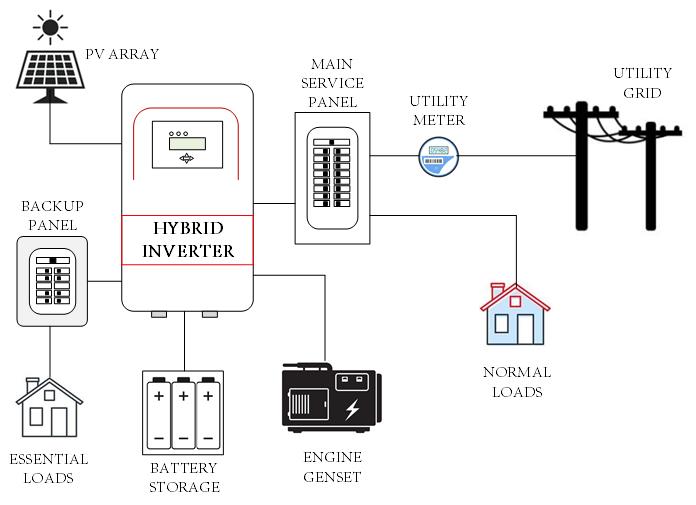
DC and AC coupled scalable Solar-Plus-Storage Hybrid designs
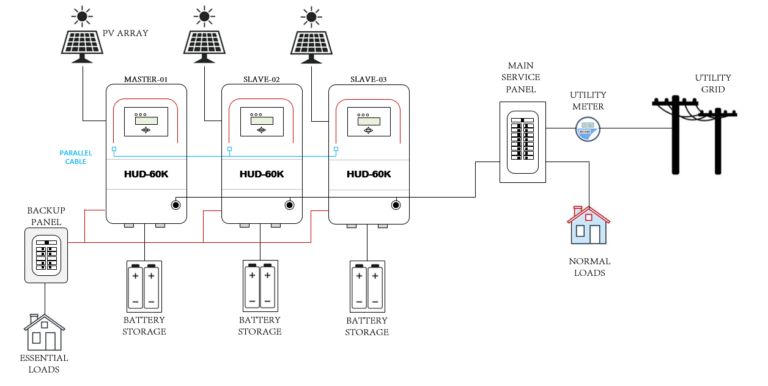
- Stacking multiple hybrid inverters in parallel for large-scale facilities
- 60kW units scalable to 600kW | Ten inverters in parallel
- 150kW units scalable to 600kW | Four inverters in parallel
- 250kW inverters stackable 1000kW
- 500kW inverters scalable to 2.0MW and beyond
Importance of DC/AC Ratio
- DC/AC ratio, also called Inverter Loading Ration (ILR), is an indicator of the effective utilization of the inverter.
- The ILR for a typical PV system increases utilization of the inverter which in turn reduces the overall Levelized system cost.
- The greatest economic benefit is derived at certain sizes of PV and battery combinations. Battery capacity beyond certain size prohibits the solution to be financially viable. ROSEC Solar determines the most optimal combination of PV Array size, hybrid inverter, DC/AC Ratio, and battery capacity.
- Optimum DC/AC ratio maximizes NPV (Net Present Value) and shortens ROI
DC and AC coupled scalable Solar-Plus-Storage Hybrid designs
Single phase inverters
Three-phase string inverters with MPP Tracking
Microinverters-based hybrid designs / Enphase
DC Optimizers-based hybrid designs / SolarEdge
LV and HV Batteries
Remote monitoring and control.
Residential to C&I Scale Solutions:
Single phase inverters | 240/120V
Three-phase string inverters with MPP Tracking | 400V/480V/208V/220V
Microinverters-based hybrid designs / Enphase
DC Optimizers-based hybrid designs / SolarEdge
LV and HV Batteries
Remote monitoring and control
Smart Load Management based on available solar power, grid power, SOC status, and load priorities.
Four Topologies for pairing photovoltaics with batteries
- DC-Coupled, AC-Coupled, Reverse DC-Coupled, and hybrid AC&DC-Coupled
- DC-coupled BESS captures energy from the PV array which will otherwise be clipped due to inverter limitations.
- AC-Coupled BESS design for new installations
- Retrofitting through AC-coupling: Designing Battery Storage for integration with an existing grid-tied solar PV systems
- Hybrid AC&DC-Coupled solutions for microgrids and facility-scale applications
Modeling and Simulation
Explore the technical and financial insights of increasing ILR on your PV-Plus-Storage projects through detailed modeling and simulation in PVsyst and SAM
Get simulate and analyze the performance of your DC-coupled or AC-coupled solar-plus-storage system under various configurations.
We can effectively apply parametric simulation techniques to analyze and identify areas for improvement in the solar-plus-storage designs or battery dispatch strategy und er the given tariff structure.
Time Shifting of PV-generated Energy to Peak Evening Hours to take benefit of the TOU pricing scheme